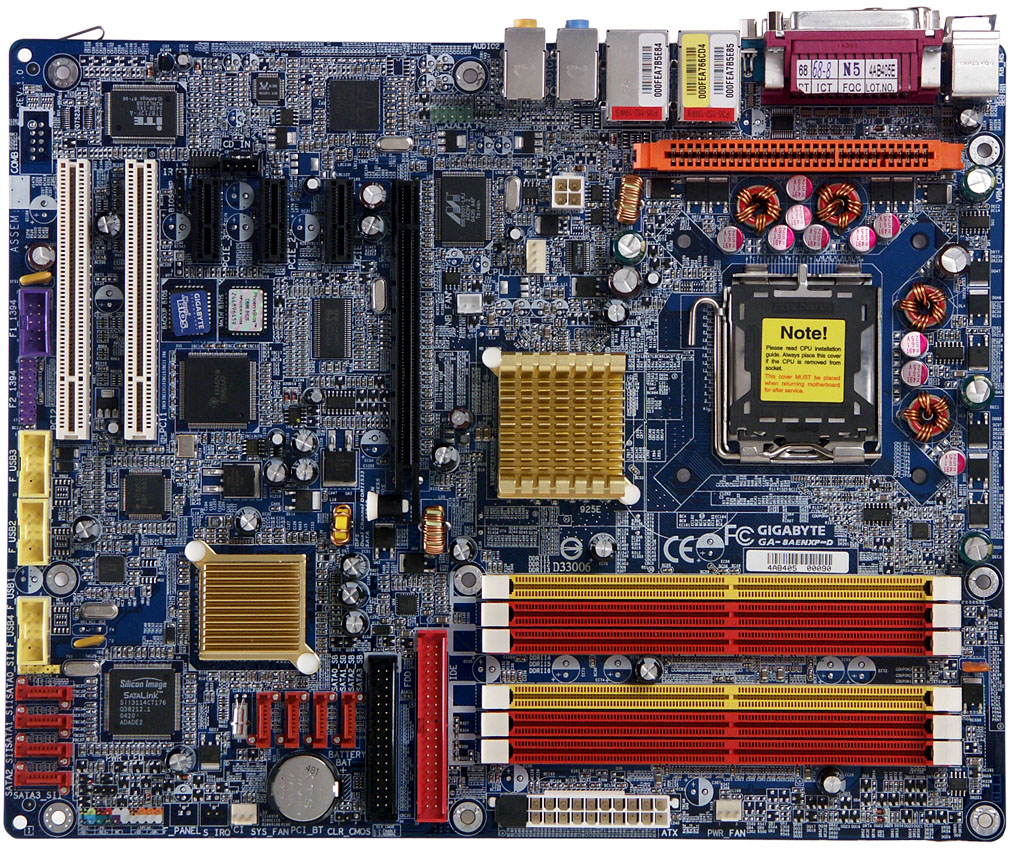
There currently appear an increasing number of motherboards based on the recently released and well-advertised Intel 925XE chipset. Motherboards on this chipset are very often practically no different from their i925X predecessors. The new motherboard from Gigabyte is not an exception. It looks very much like Gigabyte 8ANXP-D, except for the support of Intel Pentium 4 Extreme Edition and 1066 MHz FSB.
Gigabyte GA-8AENXP-D is the top model in the series for Intel processors, so it is bundled according to its high status and possesses corresponding functionality. I would like to note that the manufacturer laid stress on the functionality of the motherboard instead of on "bells and whistles": eight Serial ATA connectors — this is quite "capital" even for these days. We should also note a very good quality of the integrated audio, based on Realtek ALC880 HD Audio.
The PCB layout is ordinary — inconvenient placement of connectors along the left edge, FDD and PATA connectors are behind the video slot, the audio connector is in front of the PCI-E 1x slots. Access to the jumper is not hampered, when the motherboard is in a PC case, its description is provided on the PCB. The 4-phase switching voltage regulator of the processor incorporates two 1500 uF capacitors, four 1000 uF capacitors, and nine 560 uF capacitors. The PCB also contains voltage regulators for the PCI-E x16 bus (4 x 1000 uF) and for memory (6 x 1000 uF).
The PCB layout provides space for a COM port connector, which is left empty. Motherboard dimensions 305x245 mm ("wide" ATX, nine-screw mount, all motherboard edges are firmly fixed). System monitoring is performed by the ITE IT8712F-A chip.
We used BIOS 1.02F, the latest available BIOS version at the time of our tests.
Performance
Gigabyte GA-8AENXP-D demonstrates the best test results among the motherboards based on i925XE that we have tested. Differences between motherboards' test results are insignificant, so it's hard to say for sure which motherboard is faster. And, of course, a couple of seconds must not play a pivotal role when choosing one of these motherboards.
Test
Foxconn 925XE7AA (DDR2 533)
ASUS P5AD2-E Premium (DDR2 533)
Abit Fatality AA8XE (DDR2 533)
MSI 925XE Neo Platinum Edition (DDR2 533)
Gigabyte GA-8AENXP-D (DDR2 533)
Archiving with 7-Zip, min:sec
7:53
7:53
7:33
7:34
7:18
Memory read rate, MB/sec
2978
3021
2995
2992
3421
Memory write rate, MB/sec
1246
1362
1230
1220
1558
MPEG 4 (XVID) Encoding, min:sec
5:25
5:43
5:24
5:25
5:15
MPEG 4 (DIVX) Encoding, min:sec
3:57
4:14
3:56
3:56
3:51
Processing images in Photoshop, min:sec
35:20
35:16
34:30
34:36
33:05
Unreal Tournament 2004 (Fast@800x600x32), fps
69
67
69
68
72
Unreal Tournament 2004 (High@1280x1024x32), fps
64
63
65
64
68
Conclusions
Gigabyte products have always been a model of reliability. The new GA-8AENXP-D motherboard is not an exception. Besides, this model can boast of almost ultimate functionality, excellent performance, and very good quality of integrated audio.
But there is still a fly in the ointment of Gigabyte GA-8AENXP-D: for some unknown reason our sample refused to operate well with DDR2 Corsair XMS2 DDR2 PRO modules, so we had to replace them with XMS2 DDR2 TWINX. Considering very good performance results of this product in our tests, it will be logical to assume that it's a "price of speed", sort of: perhaps, some default timing values are a tad too "aggressive" (we traditionally use BIOS Optimal Defaults + By SPD in our tests, that is the settings used by the majority of users).
When we first took a look at a motherboard from Gigabyte, we were more than impressed by the product presentation and the extra features and products that came along in the package. Gigabyte, in my personally opinion, supplies the best product packages for the buck. Today we’ll be taking a look at Gigabyte’s latest motherboard based off of the “aging” VIA KT400 chipset. As many of you may already know, the nForce2 chipset currently holds the crown for performance when it comes to AMD based solutions. With the upcoming release of the new VIA KT400A motherboards, KT400 motherboards should be dropping in price and boards such as the GA-7VAXP Ultra will become great bargains. We’ll be pitting our Gigabyte GA-7VAXP Ultra against the Leadtek K7NCR18D-Pro in today’s tests to show you the performance difference between these chipsets, among the several other items we also look at. Let’s start off by taking a look at the official specifications as listed by Gigabyte.
..:: Specifications ::..
Processor
Socket A for AMD Athlon™ XP / Athlon™ / Duron™ Processor
1 x 2ports USB 2.0 Connector (by cable with rear USB bracket)
2 x SATA Connectors
2 x Cooling Fan Headers
Expansion Slots
1 x AGP 8x/4x/2x AGP 2.0 Compliant
5 x PCI (PCI 2.2 Compliant)
Rear Panel
PS/2 Keyboard / Mouse Connector
2 x USB 2.0 ports
2 x COM ports
1 x RJ45 LAN port
Audio (1 x Line-in / 1 x Line-out / 1 x Mic) Connector
1 x Game / Midi port
Form Factor
ATX (4 layers)
30.4cm x 23.5cm
..:: GA-7VAXP Product Package ::..
As soon as we opened up the box when it arrived, we knew we were looking at one of the best bang for your buck KT400 motherboards on the market. If memory serves me correct, the GA-7VAXP Ultra’s package could quite possibly be the largest that has ever graced our presence here in the MBReview testing lab. Since I really have no idea where to start since there is such an incredible amount of items included in the package, here is a quick rundown. First off, the GA-7VAXP Ultra comes along with a large orange sticker that displays the motherboard layout, along with the locations of each of the jumpers, and the various headers. We saw a similar sticker included back in our GA-8IEXP review, and it is surely a nice inclusion for any user. The GA-7VAXP Ultra also comes with the usual fold out instruction guide that will send you step by step through building your PC to get things up and running, yet another nice feature.
As far as external expansion brackets go, the GA-7VAXP Ultra could easily fill up your PCI slots if you so chose to utilize each of the available expansion brackets. Yes, there is indeed that many. First off we have the GC-SATA card. This card is equipped with two rear SATA connections, along with a rear SATA power connector. On the “front” of the card, there are two more SATA connectors along with a Molex power connector. To complete the SATA package, Gigabyte also includes a Molex adapter for those power supplies without the proper SATA device power connectors. This adapter allows for use of two SATA devices. There is also a single SATA cable included in the package of the GC-SATA card. The next expansion bracket we come across is the three-port IEEE1394a bracket. Each of these ports has their own connector on the motherboard as we’ll see later in the review. The next expansion bracket is for USB 2.0 support. This bracket is outfitted with four USB 2.0 ports and requires two connectors on the motherboard for use of all four ports. The last expansion bracket is for the onboard audio. This bracket provides support for rear and sub/center channels for your speaker system. It also features the S/PDIF digital out connector, and the RCA connector. All in all, we have four, yes four expansion brackets!
The remainder of the GA-7VAXP Ultra’s package includes items such as two Serial ATA cables, the GA-7VAXP Ultra user manual, a SATA RAID Function manual, a Promise RAID Function manual, a special rear I/O bracket to allow for the positioning of the rear I/O ports, one lengthy floppy ribbon cable, three ATA/133 ribbon cables, and of course the driver / software CD. Many times in the past we have seen manufactures throw in support for RAID, yet they always seem to skimp out on the cables they provide in the package. Needless to say with two Serial ATA cables and three ATA/133 cables, Gigabyte has clearly supplied everything you’ll need for the GA-7VAXP Ultra.
If you read our review of the GA-8IEXP a few months back, you may remember that we were initially unimpressed with the included user manual that was provided by Gigabyte. It ran over several areas very nicely, but if you wished to learn more about the BIOS you had to go online in order to find out about settings. To quote myself, “The user manual that is included with the GA-8IEXP is rather poor as it fails to cover any of the real BIOS settings.” Well, the GA-7VAXP Ultra manual does not face the same plight as did the GA-8IEXP’s. The manual that is included with the GA-7VAXP Ultra clearly goes over the BIOS settings is great detail, and still retains all of the detailed setup instructions that the GA-8IEXP manual featured. Gigabyte also includes nicely detailed instruction manuals for setting up both a regular RAID Array, and a SATA RAID Array through two separate manuals.
The driver / software CD houses the drivers and software for the KT333 and KT400 based Gigabyte motherboards, so if you’re looking to find a driver, this would be the place to do it. When you first insert the disc into your CD-ROM, the main window will pop up right to the driver install window. Here, you simply click which drivers to install and you’re good to go. The next window that’ll be important is the Utilities window. Here you’ll be able to install all of the third party software, and Gigabyte’s own software onto your system. The included software suite is very nice, and unlike the last time, I was able to get the Easy Tune overclocking program to work. One of the nicer inclusions within the software package is that of Norton Internet Security. This software package includes the likes of Norton Anti-Virus, Personal Firewall, Parental Controls, etc. Gigabyte has also chosen to include their Windows-based BIOS writer, along with a basic system monitoring utility. Overall the Gigabyte GA-7VAXP Ultra comes along with nothing less than an exceptional package.
..:: GA-7VAXP Feature Set ::..
The GA-7VAXP Ultra doesn’t skimp out on features; in fact it matches the exceptional package. This motherboard is the new king of the hill for both package quality and amount of features, for the time being. The GA-7VAXP Ultra comes along with a Realtek 8100BL Ethernet 10/100Mb LAN Controller, Promise PDC20276 RAID controller, Realtek ALC650 6-Channel Audio Codec, Silicon Image Sil3112A SATA RAID Controller, VIA VT6306 IEEE1394a Controller, along with support for USB 2.0 and other items through the KT400 chipset. Let’s take a better look at each of these chips, and then head on to the motherboard layout.
Gigabyte 8INXP (Granite Bay) Motherboard : Intro and Specs
Out of the box performance of almost all motherboards based on a particular chipset is almost identical, give or take a couple of points. Thus manufacturers look for alternate ways to attract a consumer- some focus on price while others focus on features. Now features can be divided into two: non-specific features like Serial-ATA, onboard NIC etc. that any manufacturer can implement on their boards and manufacturer-specific features like MSI’s DLED or ASUS’ Q-Fan. These are features that you’ll only find in a specific manufacturers models and this is something that a lot of motherboard manufacturers focus on as it makes their product unique amongst others.
Gigabyte’s most famous feature has been their dual BIOS and it’s been a while since we’ve seen something innovative from them. Sure, they’ve been creative with the use of colors for different onboard components but we haven’t really seen any new hardware specific feature from them. Well, the waiting period has finally ended as Gigabyte releases their GraniteBay chipset motherboard with something called DPS- the Dual Power System
CPU:
Supports 400/533MHz System Data Bus Intel Pentium® 4 Socket478 processor
Chipset:
Intel® E7205 MCH Intel® 82801DB ICH4
Memory:
Dual DDR200/266 ECC support Max capacity: Up to 4 GB by 4 DIMM slots
With its recent two-punch product unveiling, Palm focused on delivering excellent value products for low and mid-range buyers. The Z22 is a bargain at $99 and delivers all the calendar and contact tools that Palm is known for. (Look for our review of this device next week.) The mid-range TX ($299) is a good all-around business and personal tool, and is the lowest price Palm ever to include Wi-Fi.
At a product meeting years ago, a Palm representative told us that $300 was an important price point because it's the dividing line between when a shopper will buy a gadget on impulse and when he or she needs to check with a spouse. We're not sure if that was in their mind with the TX, but it's certainly nicely affordable for what it offers.
You'll get Bluetooth (1.1) and Wi-Fi (802.11b), a decently fast 312-MHz Intel processor, and 128MB of storage.
Front View
Buying Choices:
For Palm T|X Handheld Products from online stores:
Palm is once again renaming its handhelds, and we hope it sticks with this system for a while. It's dropping the Tungsten and Zire titles and going with initials. That makes this the successor to the Tungsten T5 (see palmOne’s Bold Guess), which currently costs $50 more and offers more storage (256 MB to the TX's 128 MB) and a faster processor (416 MHz). But the T5 doesn't have built-in WiFi, which is a huge shortcoming.
Odds are that you'll rarely run processor-intensive apps on your Palm and that you'll never fill it up (and if you did, you could buy a storage expansion card). But checking e-mail is something you'll want to do daily.
Rear View
Looking Good
The Palm TX's exterior doesn't hold many surprises, just the standard Palm good looks. You'll first notice the vibrant 320 x 480 high resolution screen, which always looked crystal clear in our testing.
A row of buttons along the bottom of the TX lets you call up the Home screen (press it to switch between icon and list views), calendar, contacts, and the Web browser. A 5-way navigation button in the middle lets you move around or select items.
The TX comes with a flip screen cover, which you attach to a slot on the left-side of the handheld. It's nice to have, although we wish the TX came with a fuller case with a belt clip.
The top of the TX holds the power button, 3.5mm stereo audio jack, Multimedia/SD/SDIO expansion card slot, and stylus. The stylus is elegant and silver, but isn't spring-loaded, like with other higher-priced models. The dock connector is on the bottom.
Palm TX with Stylus
We're surprised that this unit doesn't have a voice recorder. Perhaps that was one of the concessions Palm made to keep the unit so trim (it measures 4.76 x 3.08 x 0.61 inches and weighs only 5.25 ounces). We don't miss it, but if you frequently take voice notes, you'll want a different handheld. Palm saves voice recording for its higher-end models: Zire 72, Tungsten C, and LifeDrive Mobile Manager.
Another concession is that this Palm doesn't come with a cradle. It might be a small point, but we'd rather have the Palm standing at attention by our computer, rather that lying down on the job. The TX simply comes with a USB sync cable.
Palm TX with Charging Cable
Performance Plus
Wi-Fi Palm handhelds have always been known for ease-of-use, and the TX doesn't disappoint. We love how easy it is to find a wireless connection with the TX's software, for example. From the row of on-screen buttons along the bottom of the screen, select the Wi-Fi button (it looks like three signal strength bars).
When the Wi-Fi control panel comes up, click the Scan/Setup button to see all the wireless networks available to you. The results show the signal strength of each network as well as whether or not they're secured (by WEP or WPA). That makes fast work for a traveler to find a strong, open connection—much easier than with a Windows Mobile device.
Software Software includes the Blazer Web client, which rendered pages quickly in our testing. We especially like its bookmarking controls, which give you large buttons to click for each bookmark, so that you won't accidentally select the wrong one.
Blazer
The TX also comes with the Versa 3.1 mail client, which is easy to use and includes a short cut wizard that makes it quick to set up accounts for all the popular e-mail systems.
The software bundle also includes PTunes (for listening to your MP3s), a media player for viewing pictures (even slideshows) and movies, the professional edition of DataViz Documents To Go 7 (for viewing and editing Office documents), an SMS application, a world clock, and Palm's usual excellent bundle of calendar, contact, memo, and to-do apps. It runs on the Palm OS 5.4 (called Garnet).
Landscape Mode
Excel
We admire how well the operating system does at making controls easy to find. The on-screen row of buttons on the bottom of the screen gives access not only to Wi-Fi and Bluetooth, but also lets you change the screen orientation between portrait and landscape, access pulldown menus, and hide the on-screen text input area to get more viewing area.
Power Battery life isn't as good with the TX as we'd like. If you're a heavy user, you'll need to charge it every night. In standard use, we got between 4 and 4 1/2 hours, but with Wi-Fi on we only got half that. Like other Palm, the TX warranty covers the hardware for one year and the OS and software for 90 days.
Conclusion With the inclusion of Wi-Fi into a mid-range handheld, Palm has made the TX into a great all-around performer. It's small and light enough to carry in a shirt pocket, yet it has enough processing power and storage space to keep even a dedicated user happy.
People looking for a Palm that doubles as a music player will want the LifeDrive and people who want a phone built-in should look to Palm's highly successful Treo line. The TX doesn't have a built-in camera, as the Zire 72 does, and it lacks the Tungsten C's voice recorder and QWERTY keyboard. But if you can do without those, we think the TX is an excellent choice.
Palm TX Did you know your purchase of the Palm TX entitles you to Documents To Go Premium Edition for only $29.99? Download a free trial or upgrade today!
www.dataviz.com
Palm TX Did you know your purchase of the Palm TX entitles you to Documents To Go Premium Edition for only $29.99? Download a free trial or upgrade today!
www.dataviz.com
Find Local Handymen Here! Find Local Handymen at Service Magic. Our Service is Quick, Free, and No Obligation Required. Get Contractors to Compete for Your Business Today!
www.ServiceMagic.com
Damn nice thing first - to Gadget Guy aka Jack - thas just crap. There are severel good freeware Filebrowser out there - and btw - the file dident get saved cause no Application is registerd for the *.3gp fiel at beginning. The TX is running with the highest securit...more
Submitted by: Sky
Abismal !!!DO NOT BUY THE PALM TX!!!I downloaded a 3gp movie from a phone using bluetooth and it just disapeared, there is no way I can find it because there is no file browser on the TX. I also tried to set it up to use my router but it ...more
Submitted by: Gadget Guy
Aweful !!!DO NOT BUY THE PALM TX!!!I downloaded a 3gp movie from a phone using bluetooth and it just disapeared, there is no way I can find it because there is no file browser on the TX. I also tried to set it up to use my router but it ...more
Windows is a registered trademark of Microsoft Corp.
BlackBerry is a registered trademark of Research in Motion Limite
Now we consider about the laptops:
Sony Unveils VAIO AX Digital Studio Notebook — Cormac @ 15:24
Sony unveiled its new VAIO AX Digital Studio PC, positioned as a mobile multimedia center. The new system features a 17" WXGA+ widescreen display with Sony's original XBRITE LCD technology. Users can also watch and record high-quality television with a removable TV tuner and Microsoft Windows XP Media Center Edition 2005. Also in the box is a DVD+R Double Layer/DVD±RW drive with Sony's Click to DVD software.
The VAIO AX notebook includes a multi-function bay for adding other necessary components. One can swap a TV-tuner Bay Unit, a DVD+R Double Layer/DVD±RW Bay Unit, an optional CD-RW/DVD-ROM Bay Unit, an optional 80GB HDD Bay Unit, and an optional HDD Adapter Bay Unit. The optional docking station with an additional multi-function bay provides even more options. The VAIO AX notebook also sports an integrated 0.3 mega-pixel camera for video chatting and a built-in fingerprint sensor. The notebook also comes standard with a multitude of connector interfaces, including an i.LINK® (IEEE 1394) and two USB 2.0 ports as well as Memory Stick and Secure Digital media slots.
Speaking of software, the model comes with a full suite of Sony multimedia applications, including SonicStage Mastering Studio software for managing music in a variety of formats and DVgate Plus software for capturing and editing both standard definition and high-definition (1080i) video.
Sony VAIO AX notebooks will be available next month starting at about $2,000. They can be purchased at national retailers, online at SonyStyle.com or at SonyStyle stores. Pre-orders begin online today at www.sony.com/ax.
Of course it's a subjective opinion, but Toshiba notebooks have always attracted me by their combination of technical solutions and original design. That's why the first impression produced by Toshiba Qosmio F10 was... disappointment. The design seems too inexpressive. However, the design impressions soon paled into insignificance. But let's not put the cart before the horse.
Technical characteristics of Toshiba Qosmio F10 (claimed by the manufacturer)
Processor
Intel Pentium M 735, 1.7GHz (our sample was equipped with Pentium M 755 2 GHz)
Chipset
Intel 855PM
RAM
SDRAM DDR PC2700 up to 2048 MB (the sample under review had 1024MB)
Display
15.4" Toshiba TruBrite WXGA with wide angles of view (HCSV), 1280*800, 16.7M colors
Graphics
GeForce FX Go5700 128MB DDR SDRAM
Audio
AC'97 SoundMAX codec
HDD
80GB (our sample was equipped with Toshiba MK8026GAX)
Optical storage
Built-in DVD Super Multi (Double Layer)
Reading: 24x CD-ROM, 8x DVD-ROM
Recording: 24x CD-R, 10x CD-RW, 8x DVD-R, 4x DVD-RW, 8x DVD+R, 2,4x DVD+RW(Double Layer), 4x DVD+RW, 3x DVD-RAM
(our sample was equipped with Matshita DVD-RAM UJ-831S)
PCMCIA
1xType II
I/O ports
1 headphones jack combined with S/PDIF
1 x microphone jack
1 x VGA port/Mini D-sub 15-pin for an external monitor
1 x S-Video Out
1 x D-Video Out
1 x S-Video In
1 x Monitor-in
1 x RJ11 Modem jack
1 x RJ45 LAN jack
4 x USB 2.0
1 x IEEE1394
Card Reader
Bridge Media slot (SD, xD Picture Card, Memory Stick, Memory Stick Pro, Multi Media Card)
Communications:
Ethernet 10/100
Fax modem (v.90 v.92)
Wi-Fi 802.11 b/g (optional, installed in our sample)
Bluetooth (optional, not installed in our sample)
Dimensions and weight
373 x 285 x 43 mm
3.77 kg
Power supply
Li-Ion batteries
100–240V AC adapter
According to the Russian Toshiba web site, Qosmio combines audio, video, and PC into a single mobile digital multimedia system. Various video connectors back up these words. The notebook can input and output both analog and digital video. The set of audio jacks is standard. Theoretically, S/PDIF Out is sufficient, but the same input is not available.
Package Contents:
We tested a sample with minimum configuration. The bundle depends on a configuration and is published on Toshiba web site.
First Impressions
As I have already written, the exterior of the notebook disappointed me a little, when I saw it for the first time. It's a standard "brick", silvery-topped and gray-bellied. It looks much worse than Satellite M30, to be frank. I repeat, this is my subjective impression. Perhaps, I fail to keep up with the present. Let's take an all-round view of the notebook.
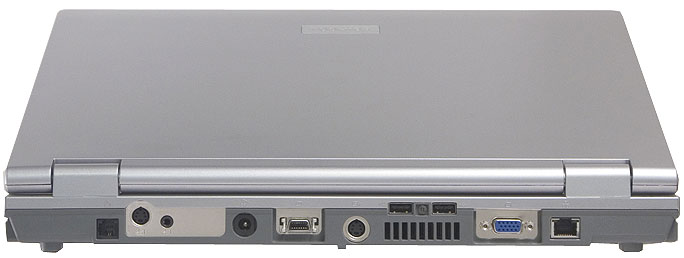
The rear panel (from left to right)
Phone line connector
Group of video inputs (S-Video In and Monitor-in) on a metal plate. The same plate may contain an TV antenna jack for a TV tuner, not available in our sample
Power cable connector
D-Video Out
S-Video Out
2 x USB (with air grating below)
VGA port
LAN port
As you can see, the variety of video jacks must theoretically satisfy any exacting user. Monitor-in is intended for an analog video source connected via the bundled RCA adapter (Audio-Left, Audio-Right, Composite Video).
The left flank (in the same order)
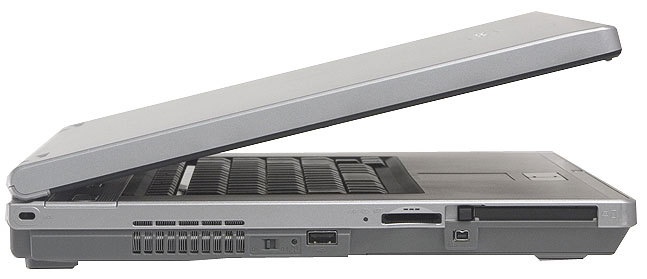
Kensington lock hole
Air grating
Wireless switch with an indicator
USB port
BridgeMedia slot
PC Card slot
IEEE1394 (under it)
Right flank (in the same order)
Volume control
1 x headphone / S/PDIF
Microphone jack
Optical drive
Another USB port, vertical orientation
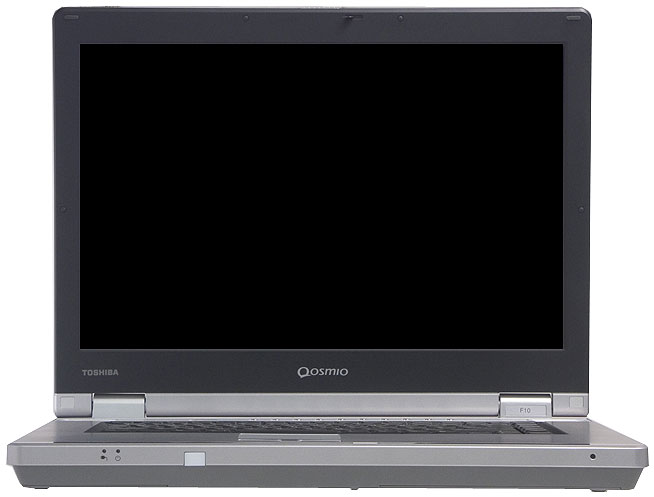
The front panel houses indicators for main power and notebook status, a dummy panel (some models are equipped with IrDA here), a display lid latch, and a mike. The mike is located in an original place, not quite optimal.
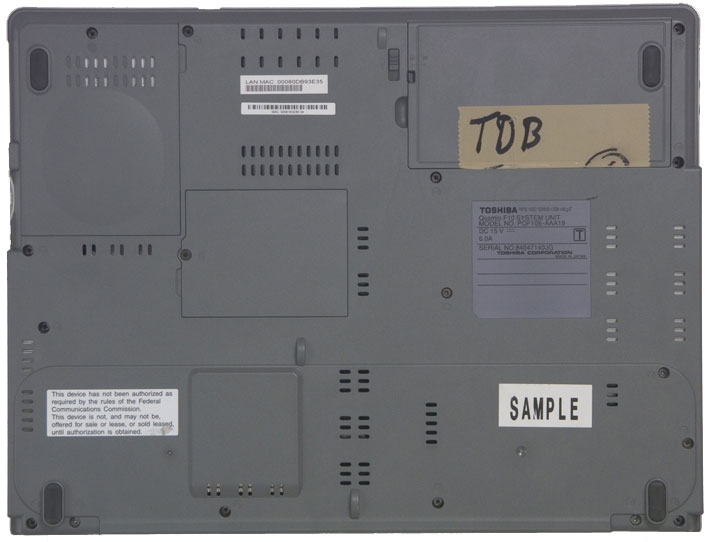
The bottom houses a battery (top right on the photo), HDD (top left) and memory (center) bays.
Ergonomics and usability
Let's open the lid. It should be noted that the notebook looks more attractive when you open it. Now we can talk about the strict design.
The keyboard is rather convenient, but the layout of our sample differed from the traditional: «@» and «#» are obviously out of place. I like that the Ins and Del keys are to the right of Space. But I don't like the short Space. Unfortunately, it takes rather long to get used to this layout. Sticky Fn seems to me rather convenient, it saves you the trouble of holding it down for Fn+F1..F12 combinations. This feature is implemented in Toshiba Utilities. There are also some interesting hot key combinations - for example, Fn+Space changes screen resolution, Fn+4 switches to playback mode from the analog video-in. Detailed description of these combinations are published in the user's manual.
Caps Lock indicator is right on the corresponding button. Scroll Lock and Num Lock are located on the insert that separates a row of functional keys.
Several buttons are scattered over the keyboard. Aside from the power on button, these keys include (from left to right)
browser launch button
CD/DVD player launch button
TV output button
brightness level control
Toshiba Zooming Utility
The touchpad is quite convenient, even my favorite scroll button is supplied.
Built-in speakers produced an ambivalent impression. The sound is quite clear, but it noticeably lacks basses even compared to notebooks with subwoofers. That's why the sound in movies with lots of special effects is not expressive enough.
Qosmio Player plays back CD and DVD without booting into an operating system. It requires a 100 MB partition to be installed (readme recommends 200). Playback is controlled with a row of buttons over the keyboard. The player is configured by hot key combinations. You are strongly recommended to read the user's manual to get to know how to control the player.
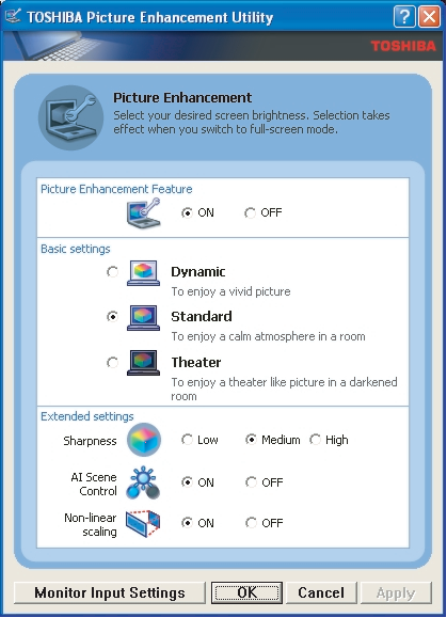
You can choose one of the three available image quality modes.
Dynamic: increased brightness.
Standard: standard indoors usage.
Theater: intended for dark rooms, provides the theater presence effect.
You can also choose one of the three sharpness levels: Low, Medium, or High.
Here is a screenshot of TOSHIBA Picture Enhancement Utility.
Matrix
The matrix is probably the most striking part of this notebook. It leaves a wonderful impression. Subjectively, it's the best notebook panel I have ever seen. Bright saturated colors, wide viewing angles... The only drawback is glares, which you can see on the photo of additional buttons - the keyboard is reflected in the display. So you'd better watch movies, when the lights are subdued. You can look at the complete instrumental test results here, the main results are published in the table.
Response time, ms
Parameter
Mean
Abmodality
Angles of vision
min., %
max., %
CR
Horiz.
Vert.
on
19.9
black spot brightness
0.91 cd/m2
-16,7
14.6
10:1
130
115
off
5.9
white spot brightness
285.7 cd/m2
-8
6.4
5:1
160
160
total
25.8
contrast
316:1
-12,2
13.2
The response time is average. High level of black spot luminance can be explained by the maximum brightness setting. It should be noted that the contrast is very good in this mode as well. Wide angles of view save the trouble of adjusting the panel position whenever you move. Rather high nonuniformity of black and white spot brightness is almost invisible by eye - you will notice that the bottom part of the panel is brighter only in very dark scenes.
Warranty and Tech Support
The notebook is backed up by 2 years of international warranty. Authorized service center - CEPCO. HD - Moscow, Soviet Army St, 5, Phones: (095) 684-5577, 684-5880, 684-5881, Web-site: http://www.cepco.ru. The list of service centers in other cities is published on the Russian Toshiba web site. The web site also offers E-Support.
Testing the notebook
The notebook is equipped with a relatively rare video card - GeForce FX Go5700 128MB. Unfortunately, there can be no correct performance comparison to models with ATI graphics. The only model on the 8555 chipset with Dothan processor that passed our tests is ASUS M6Ne, but its ATI Mobility Radeon 9700 is equipped with 64MB. 128MB of video memory are installed in MaxSelect TravelBook X7+, but its CPU clock is just 1.7GHz. It can't be helped, we'll publish the results of these models for comparison (where justified), MaxSelect will be included just for a crowd.
BAPCo/MadOnion MobileMark 2002 Productivity workload (Battery life rating)
136 minutes
BAPCo/MadOnion MobileMark 2002 Reader workload (Battery life rating)
143 minutes
Battery run-down time for a 4 kg notebook is evidently not the most important mode. Nevertheless, the model survives more than two hours on its batteries.
And now — 3D graphics. MadOnion 3DMark 2001 SE (32 bit color, 32 bit Texture Format, NoAA, 24 bit Z-buffer depth, Frame Buffer — Double buffering, Game Performance)
I'll publish a separate diagram with the results in wide screen modes.
Now — 3DMark03. All test settings are by default.
Here is a separate diagram for wide screen modes again.
Unfortunately, the maximum resolution of the panel from Toshiba is lower. But it demonstrates excellent performance in supported modes and outperforms ASUS.
And finally here go the tests in OpenGL games. The sound card is disabled.
Here the Toshiba model is at advantage again. The higher the image quality, the higher the advantage.
An interesting situation - Qosmio performance grows considerably in 32-bit color mode
Overall Bottom Line. Conclusions
So, what do we get? Excellent panel, excellent performance for a notebook on the 1st generation Centrino platform, including 3D graphics. Plus DVD Super-Multi that can record double-layer discs. Design? Firstly, I have already written that the design gradually pales into insignificance. Secondly, tastes differ.
The editors express their thanks to the representative office
of Toshiba in Moscow for the provided notebook.
Of course it's a subjective opinion, but Toshiba notebooks have always attracted me by their combination of technical solutions and original design. That's why the first impression produced by Toshiba Qosmio F10 was... disappointment. The design seems too inexpressive. However, the design impressions soon paled into insignificance. But let's not put the cart before the horse.
Technical characteristics of Toshiba Qosmio F10 (claimed by the manufacturer)
Processor
Intel Pentium M 735, 1.7GHz (our sample was equipped with Pentium M 755 2 GHz)
Chipset
Intel 855PM
RAM
SDRAM DDR PC2700 up to 2048 MB (the sample under review had 1024MB)
Display
15.4" Toshiba TruBrite WXGA with wide angles of view (HCSV), 1280*800, 16.7M colors
Graphics
GeForce FX Go5700 128MB DDR SDRAM
Audio
AC'97 SoundMAX codec
HDD
80GB (our sample was equipped with Toshiba MK8026GAX)
Optical storage
Built-in DVD Super Multi (Double Layer)
Reading: 24x CD-ROM, 8x DVD-ROM
Recording: 24x CD-R, 10x CD-RW, 8x DVD-R, 4x DVD-RW, 8x DVD+R, 2,4x DVD+RW(Double Layer), 4x DVD+RW, 3x DVD-RAM
(our sample was equipped with Matshita DVD-RAM UJ-831S)
PCMCIA
1xType II
I/O ports
1 headphones jack combined with S/PDIF
1 x microphone jack
1 x VGA port/Mini D-sub 15-pin for an external monitor
1 x S-Video Out
1 x D-Video Out
1 x S-Video In
1 x Monitor-in
1 x RJ11 Modem jack
1 x RJ45 LAN jack
4 x USB 2.0
1 x IEEE1394
Card Reader
Bridge Media slot (SD, xD Picture Card, Memory Stick, Memory Stick Pro, Multi Media Card)
Communications:
Ethernet 10/100
Fax modem (v.90 v.92)
Wi-Fi 802.11 b/g (optional, installed in our sample)
Bluetooth (optional, not installed in our sample)
Dimensions and weight
373 x 285 x 43 mm
3.77 kg
Power supply
Li-Ion batteries
100–240V AC adapter
According to the Russian Toshiba web site, Qosmio combines audio, video, and PC into a single mobile digital multimedia system. Various video connectors back up these words. The notebook can input and output both analog and digital video. The set of audio jacks is standard. Theoretically, S/PDIF Out is sufficient, but the same input is not available.
Package Contents:
We tested a sample with minimum configuration. The bundle depends on a configuration and is published on Toshiba web site.
First Impressions
As I have already written, the exterior of the notebook disappointed me a little, when I saw it for the first time. It's a standard "brick", silvery-topped and gray-bellied. It looks much worse than Satellite M30, to be frank. I repeat, this is my subjective impression. Perhaps, I fail to keep up with the present. Let's take an all-round view of the notebook.
The rear panel (from left to right)
Phone line connector
Group of video inputs (S-Video In and Monitor-in) on a metal plate. The same plate may contain an TV antenna jack for a TV tuner, not available in our sample
Power cable connector
D-Video Out
S-Video Out
2 x USB (with air grating below)
VGA port
LAN port
As you can see, the variety of video jacks must theoretically satisfy any exacting user. Monitor-in is intended for an analog video source connected via the bundled RCA adapter (Audio-Left, Audio-Right, Composite Video).
The left flank (in the same order)
Kensington lock hole
Air grating
Wireless switch with an indicator
USB port
BridgeMedia slot
PC Card slot
IEEE1394 (under it)
Right flank (in the same order)
Volume control
1 x headphone / S/PDIF
Microphone jack
Optical drive
Another USB port, vertical orientation
The front panel houses indicators for main power and notebook status, a dummy panel (some models are equipped with IrDA here), a display lid latch, and a mike. The mike is located in an original place, not quite optimal.
The bottom houses a battery (top right on the photo), HDD (top left) and memory (center) bays.
Ergonomics and usability
Let's open the lid. It should be noted that the notebook looks more attractive when you open it. Now we can talk about the strict design.
The keyboard is rather convenient, but the layout of our sample differed from the traditional: «@» and «#» are obviously out of place. I like that the Ins and Del keys are to the right of Space. But I don't like the short Space. Unfortunately, it takes rather long to get used to this layout. Sticky Fn seems to me rather convenient, it saves you the trouble of holding it down for Fn+F1..F12 combinations. This feature is implemented in Toshiba Utilities. There are also some interesting hot key combinations - for example, Fn+Space changes screen resolution, Fn+4 switches to playback mode from the analog video-in. Detailed description of these combinations are published in the user's manual.
Caps Lock indicator is right on the corresponding button. Scroll Lock and Num Lock are located on the insert that separates a row of functional keys.
Several buttons are scattered over the keyboard. Aside from the power on button, these keys include (from left to right)
browser launch button
CD/DVD player launch button
TV output button
brightness level control
Toshiba Zooming Utility
The touchpad is quite convenient, even my favorite scroll button is supplied.
Built-in speakers produced an ambivalent impression. The sound is quite clear, but it noticeably lacks basses even compared to notebooks with subwoofers. That's why the sound in movies with lots of special effects is not expressive enough.
Qosmio Player plays back CD and DVD without booting into an operating system. It requires a 100 MB partition to be installed (readme recommends 200). Playback is controlled with a row of buttons over the keyboard. The player is configured by hot key combinations. You are strongly recommended to read the user's manual to get to know how to control the player.
You can choose one of the three available image quality modes.
Dynamic: increased brightness.
Standard: standard indoors usage.
Theater: intended for dark rooms, provides the theater presence effect.
You can also choose one of the three sharpness levels: Low, Medium, or High.
Here is a screenshot of TOSHIBA Picture Enhancement Utility.
Matrix
The matrix is probably the most striking part of this notebook. It leaves a wonderful impression. Subjectively, it's the best notebook panel I have ever seen. Bright saturated colors, wide viewing angles... The only drawback is glares, which you can see on the photo of additional buttons - the keyboard is reflected in the display. So you'd better watch movies, when the lights are subdued. You can look at the complete instrumental test results here, the main results are published in the table.
Response time, ms
Parameter
Mean
Abmodality
Angles of vision
min., %
max., %
CR
Horiz.
Vert.
on
19.9
black spot brightness
0.91 cd/m2
-16,7
14.6
10:1
130
115
off
5.9
white spot brightness
285.7 cd/m2
-8
6.4
5:1
160
160
total
25.8
contrast
316:1
-12,2
13.2
The response time is average. High level of black spot luminance can be explained by the maximum brightness setting. It should be noted that the contrast is very good in this mode as well. Wide angles of view save the trouble of adjusting the panel position whenever you move. Rather high nonuniformity of black and white spot brightness is almost invisible by eye - you will notice that the bottom part of the panel is brighter only in very dark scenes.
Warranty and Tech Support
The notebook is backed up by 2 years of international warranty. Authorized service center - CEPCO. HD - Moscow, Soviet Army St, 5, Phones: (095) 684-5577, 684-5880, 684-5881, Web-site: http://www.cepco.ru. The list of service centers in other cities is published on the Russian Toshiba web site. The web site also offers E-Support.
Testing the notebook
The notebook is equipped with a relatively rare video card - GeForce FX Go5700 128MB. Unfortunately, there can be no correct performance comparison to models with ATI graphics. The only model on the 8555 chipset with Dothan processor that passed our tests is ASUS M6Ne, but its ATI Mobility Radeon 9700 is equipped with 64MB. 128MB of video memory are installed in MaxSelect TravelBook X7+, but its CPU clock is just 1.7GHz. It can't be helped, we'll publish the results of these models for comparison (where justified), MaxSelect will be included just for a crowd.
BAPCo/MadOnion MobileMark 2002 Productivity workload (Battery life rating)
136 minutes
BAPCo/MadOnion MobileMark 2002 Reader workload (Battery life rating)
143 minutes
Battery run-down time for a 4 kg notebook is evidently not the most important mode. Nevertheless, the model survives more than two hours on its batteries.
And now — 3D graphics. MadOnion 3DMark 2001 SE (32 bit color, 32 bit Texture Format, NoAA, 24 bit Z-buffer depth, Frame Buffer — Double buffering, Game Performance)
I'll publish a separate diagram with the results in wide screen modes.
Now — 3DMark03. All test settings are by default.
Here is a separate diagram for wide screen modes again.
Unfortunately, the maximum resolution of the panel from Toshiba is lower. But it demonstrates excellent performance in supported modes and outperforms ASUS.
And finally here go the tests in OpenGL games. The sound card is disabled.
Here the Toshiba model is at advantage again. The higher the image quality, the higher the advantage.
An interesting situation - Qosmio performance grows considerably in 32-bit color mode
Overall Bottom Line. Conclusions
So, what do we get? Excellent panel, excellent performance for a notebook on the 1st generation Centrino platform, including 3D graphics. Plus DVD Super-Multi that can record double-layer discs. Design? Firstly, I have already written that the design gradually pales into insignificance. Secondly, tastes differ.
The editors express their thanks to the representative office
of Toshiba in Moscow for the provided notebook.
Do you change clothes when you come home from work? You probably trade your conservative duds for something more colorful and comfortable (unless you're Superman, who dresses more colorfully when going to work).
Lenovo does the same thing: When it supplemented its ThinkPad business laptop line with a series of consumer notebooks dubbed IdeaPad, the company gave the ultralight IdeaPad U110 not a matte black but a vivid red case lid, garnished with an ornate textured paisley pattern that's even echoed on the underside with artfully cut cooling vents.
But there's more to the U110 than flash and splash. Once you admit that it's a splurge at $1,799 (a current discount from $1,899), the 11.1-inch-screened compact is an appealing civilian alternative to the super-elite $3,000 ThinkPad X300 slimline we raved about in May.
Extreme Portability
While the X300 is remarkably light for a notebook that includes an onboard optical drive, the U110 is lighter still, because (spoiler ahead) it doesn't. Instead, the IdeaPad comes with a 13-ounce external DVD±RW drive that plugs into the two USB 2.0 ports on the system's left side. (One port isn't enough to power the AC-adapter-less drive.)
Setting aside the DVD burner and the system's AC adapter (11 ounces), the Lenovo measures 7.7 by 10.8 by 0.9 inches and tips the scales at 2.4 pounds with the provided four-cell battery pack, which fits flush with the notebook for a sleek and trim appearance. As is common with ultralights, there's a larger, longer-lived alternative battery -- a seven-cell pack that protrudes slightly at the rear and below and hikes system weight to 2.9 pounds.
If you winced when you read the U110's price, you should take into account that both batteries, like the USB optical drive and a soft carrying pouch, come with the system instead of hiding as options or asterisks on a lower advertised price. Also, though the IdeaPad has a smidgen less sex appeal, it costs the same as an Apple MacBook Air with no optical drive or swappable battery.
On the minus side, while Lenovo estimates that the little and big batteries can last as long as two and six hours, respectively, our U110 fell far short of such endurance. The four-cell lasted barely an hour and a quarter in our real-world work sessions. The seven-cell averaged about three hours in mixed-use stints without the DVD±RW attached and two hours when using the drive to watch a DVD.
Besides the two USB ports, the notebook's left side offers a VGA monitor connector and an exhaust-fan vent that can get pretty warm. A third USB port, FireWire and Ethernet connectors, microphone and headphone jacks, a six-format memory-card reader slot, and an ExpressCard slot are at the right. Bluetooth is standard, along with 802.11a/g WiFi.
The small laptop makes room for a full-sized keyboard (8 inches from A through apostrophe), except for half-sized function, Delete, and cursor-control keys. The only layout quirk that takes a little adjusting to is that, while there are dedicated PgUp and PgDn keys instead of the common and clumsy Fn-key-plus-cursor-arrow combinations, there aren't dedicated Home and End keys -- those are the Fn key plus PgUp and PgDn. (Pressing the Fn key along with the cursor arrows dials the LCD backlight and audio volume up or down.)
We had to adjust to something else during our first hour or two with the U110 -- the keys, like the palm rest below them, are a glossy black that becomes smothered with smudgy fingerprints after about five minutes. They actually felt a bit slippery at first, like walking on freshly waxed floor tiles, but our fingers quickly adjusted. Call the result a medium-good but not exceptional typing feel.
The IdeaPad breaks from Lenovo's ThinkPads in not having a center-of-keyboard nub or pointing stick for mouse control, just a smallish touchpad with good-sized mouse buttons below it. It worked smoothly and nearly silently in our tests.
If you've been schlepping around a too-heavy, too-slow notebook for too long, Intel and Lenovo have given you even more reasons to buy a better laptop. The new ThinkPad X200 is Lenovo's latest ultraportable notebook, a three-pound hatchling that's ready to fly thanks to Intel's new Centrino 2 mobile-PC platform.
The X200 replaces the ThinkPad X61, slotting below the rave-reviewed but hyper-pricey ThinkPad X300 in Lenovo's lineup. Instead of the latter's 13.3-inch display, the X200 is built around a 12.1-inch screen that gives the system a footprint about the size of a sheet of paper.
Its slim profile tapers from less than an inch to 1.4 inches thick, and its light weight makes it easy to tote to meetings or slip in your bag. The exterior is the familiar ThinkPad matte black; it won't turn heads, but does give an appropriately professional impression.
Beauty on the Inside
While the X200's exterior is buttoned-down, its sex appeal lurks on the inside. Intel's Centrino 2 platform marries the latest generation of speedy Core 2 Duo processors to a faster front-side bus (1066MHz, up from 800MHz in previous Centrino solutions), which helps eliminate performance bottlenecks at the system level.
Centrino 2 also delivers an improved WiFi wireless chip including 802.11-DraftN support, as well as embedded Gigabit Ethernet networking and improved integrated graphics via a faster Graphics Media Accelerator X4500HD chip with hardware-based high-definition video decoding. Intel boasts that Centrino 2 both improves notebook performance and extends battery life.
Indeed, in our informal testing, the Core 2 Duo P8400-powered (a 2.26GHz processor with 3MB of Level 2 cache) Lenovo generally outperformed other ultraportables in the three-pound weight range, launching and running applications at speeds traditionally reserved for larger laptops. A 2.4GHz Core 2 Duo P8600 CPU is an option.
If you spend a lot of time away from an electrical outlet, you'll also appreciate the X200's battery life, which Lenovo estimates at 3.2 hours with the standard four-cell battery and more than nine hours with a 9-cell battery that hikes system weight to 3.6 pounds.
Business-Friendly Features
The ThinkPad has other features a business pro would crave. Unlike other ultraportables, which make you suffer with an undersized keyboard, the X200's keyboard is full-sized, with the famous feel and responsiveness long a hallmark of ThinkPad portables. Lenovo also provides dedicated volume and mute buttons (no more fumbling with a Fn-key combo) as well as the handy ThinkLight, a white LED above the screen that gives off just enough light to illuminate the keyboard in a dark room.
The 12.1-inch, 1,200 by 800-resolution screen is bright and exceedingly sharp. Compared to its X61 predecessor's 1,024 by 768-pixel panel, the widescreen aspect ratio keeps the height of the panel fairly squat, which makes the X200 ideal for use on an airline tray table. You can equip the X200 with an 80GB, 160GB, or 320GB hard drive; a 200GB, 7,200-rpm drive with Full Disk Encryption; or a 64GB solid-state drive (SSD) that uses indestructible flash memory instead of spinning platters. If you've ever had a traditional hard drive die on you, the allure of an SSD is obvious.
With the exception of FireWire, the X200 has all the ports you're likely to need, including three USB 2.0 ports; a VGA connector for hooking up a projector or monitor; modem and Ethernet jacks; and a PC Card slot. Options include a fingerprint reader for added login security, a Webcam for videoconferencing, and a five-format memory-card reader.
Lenovo also offers optional wireless broadband, which lets you connect via cellular carriers' high-speed networks; the WWAN option has a handy option of its own in GPS navigation. If you often find yourself paying for wireless access at airports, hotels, and other WiFi hot spots -- or find yourself someplace without WiFi altogether -- this feature can pay for itself quickly. Intel UltraWideBand and WiMAX are scheduled to appear later in 2008.
The Tradeoffs
While the X200 has a lot going for it, it does necessitate a few tradeoffs typical of the ultraportable class. First and foremost, unlike the pricier X300, the notebook doesn't have a built-in optical drive. You'll have to invest in a USB-based external drive or opt for Lenovo's snap-on UltraBase accessory, which adds a modular bay for a CD-RW/DVD-ROM, DVD±RW, or Blu-ray drive or a second battery second hard disk.
The small size of the X200 also means there was only room for the familiar ThinkPad TrackPoint pointing stick, not the touchpad most portable users have grown accustomed to. And while the notebook's built-in speaker is fine for personal use, you'll want to rely on your projector's speakers if you're given a presentation in any but the smallest conference room.
But these compromises can be said of most every three-pound PC, and the X200 does away with two of the biggest shortcomings of previous examples: so-so performance and a cramped, substandard keyboard. Even better, the base configuration starts at a reasonable $1,199. Considering its cutting-edge features and horsepower, that price makes the ThinkPad X200 a bargain to boot.
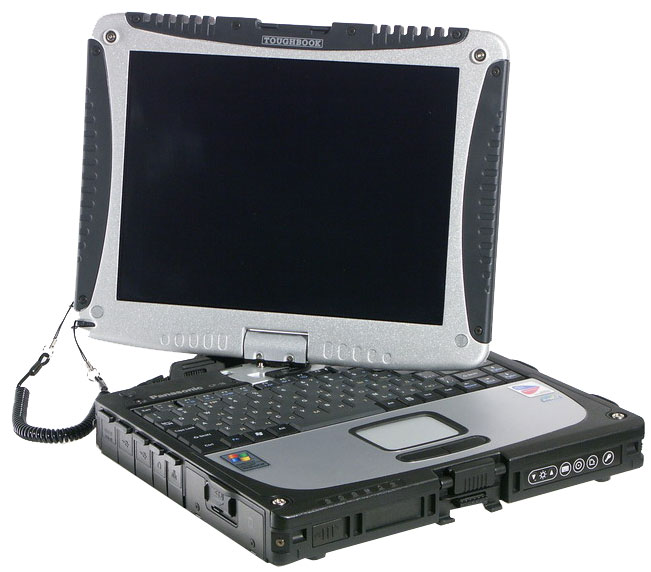
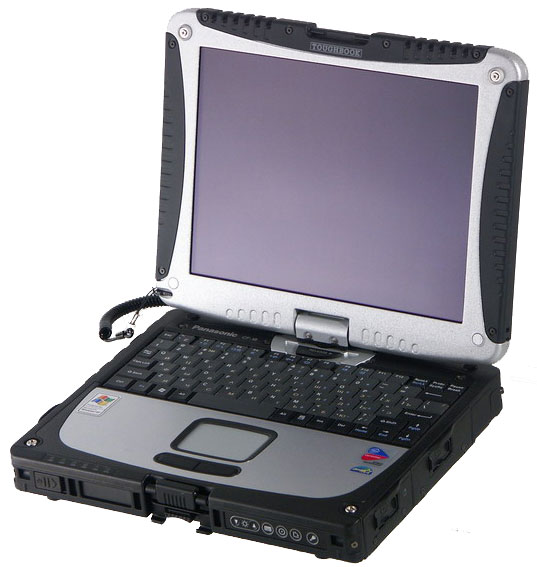
You cannot imagine a demesne, where you can do without computers these days. But what can you do, if the environment conditions are far from tender? What if you need a computer on a race route or geological expedition rather than on an office desktop? Toughbook CF-18 is designed for extreme environment conditions. Besides, it's not just a notebook, it can transform into a Tablet PC. Let's have a look at the specifications.
Panasonic Toughbook CF-18 Specifications (from the manufacturer)
Processor
Intel® Pentium M ULV 900 MHz
Chipset
Intel 855GM
RAM
256 MB DDR-266 SDRAM expandable to 1280 MB
Display
Touchscreen PC version: 10.4" 1024 x 768 (XGA) transmissive, outdoor-readable TFT Active Matrix Color LCD (on the sample under review)
Tablet PC version: 10.4" 1024 x 768 (XGA) transmissive, outdoor-readable TFT Active Matrix Color LCD with Digitizer
Graphics
Integrated
Audio
SigmaTel STAC9767 AC`97, a built-in speaker
PC Cards slot
Card Type II õ 2 or Type III x 1 (CardBus)
HDD
40 GB (our sample was equipped with Toshiba MK4021GAS)
Optical storage
External DVD/CD-RW Combo CF-VDRRT2W (to be bought separately)
I/O ports
1 x headphones jack
1 x microphone jack
1 x VGA port/Mini D-sub 15-pin for an external monitor
1 serial port (only for modifications with Touchscreen)
SmartCard Reader (takes up one Type II PC Card slot)
Dimensions and weight
4.8 õ 27.2 õ 21.6 cm (1.9"(H) x 10.7"(W) x 8.5"(D))
2 kg (4.5 lbs)
Power supply
Li-Ion battery 7.4V, 6600mAh, 4-6 hours of battery runtime
100–240V AC power adapter
It should be noted that this model currently comes equipped with Pentium M ULV 713 1.1 GHz with Intel PRO/Wireless 2200BG. The model comes in two modifications - Touchscreen PC version and with a regular Tablet PC display with an electromagnetic stylus. In my subjective opinion, Touchscreen is better for extreme environmental conditions - at least you can manipulate it with your finger. We've tested this very modification.
First Impressions
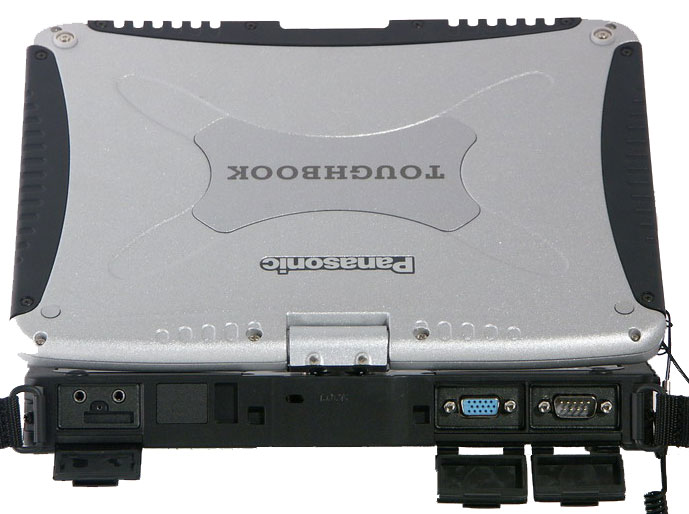
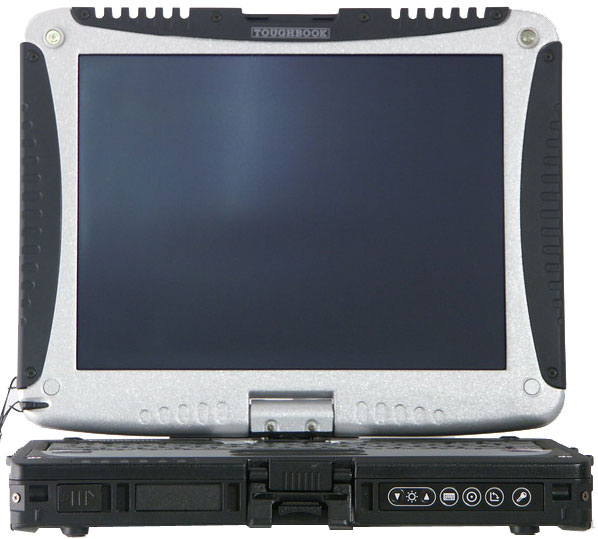
Exterior of the model is impressive. Full magnesium alloy case painted black, silvery lid with plastic rubber-like profiles. All connectors are covered with plastic caps. It has a wide fabric strap to carry the tablet PC. So, it does not go with a business suit.
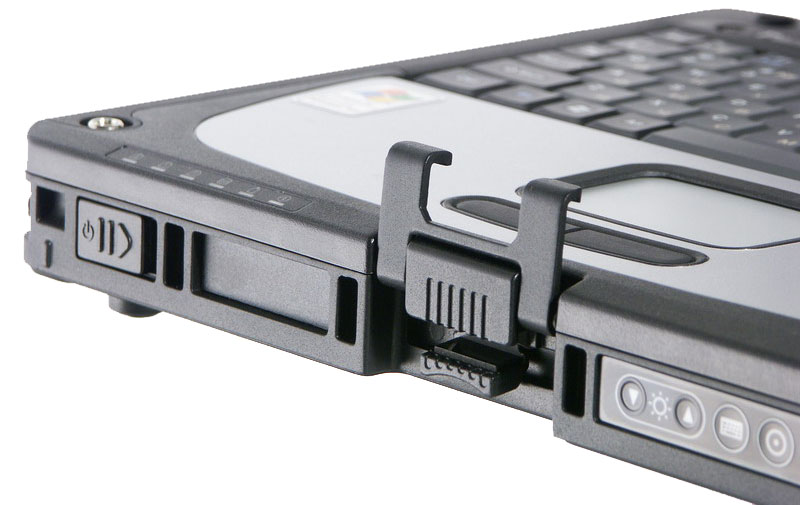
The metallic latch resembles packages with military equipment, but it is rugged.
There are three covers at the rear. A group of audio jacks is located under the left one. A video out and a serial port are on the photo on the right. Kensington lock hole is in the middle.
The front panel houses: power slider (on the left), display lid latch, and control buttons: brightness control and tablet mode buttons. These buttons will be described in detail below. The power-on slider is a proprietary solution from Panasonic, it is also used in CF-Y2. This solution is justified for a rugged notebook, but it will take time to get used to it.
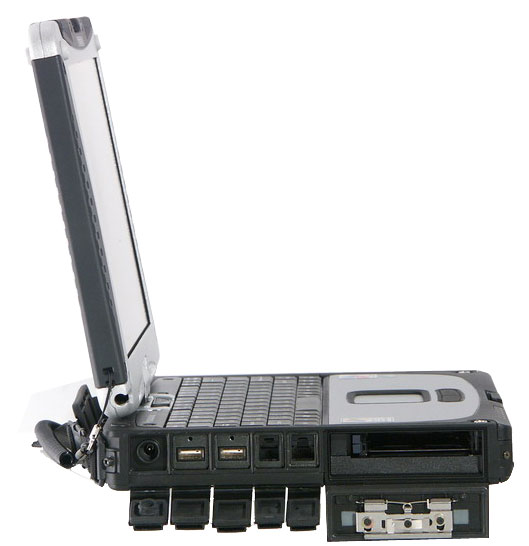
From the usability point of view, we have some gripes with the USB layout (like in the CF-Y2) — this model offers two ports behind RJ-45 and RJ-11. If a network or modem cable is plugged to the notebook, it's very inconvenient to connect USB devices. On the other hand, which is again typical of Panasonic, the layout of ports and the construction of covers allows to connect even large USB devices without adapters.
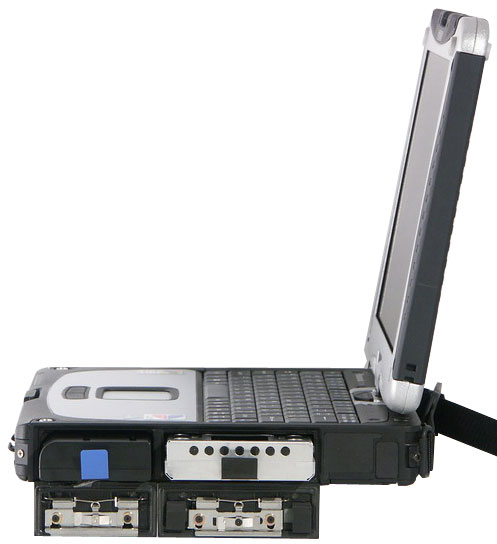
The battery and HDD bays are on the right. The HDD bay is filled with special gel that cushions shocks and vibrations. This notebook is designed in compliance with MIL STD 810F requirements (you can read about this standard here), it must endure 90 cm falls. It allows to quickly replace a HDD in case you drop it from a higher place :).
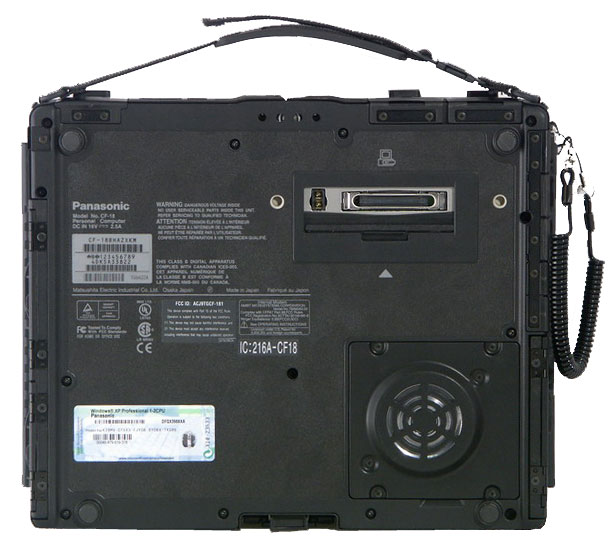
It's not a vent grid, but a speaker on the bottom. The memory bay is below it. A docking connector is covered by a sliding lid.
On the whole, this set of ports is sufficient for working under extreme conditions. They could have added IEEE 1394 though.
We haven't tested it for protection. But judging from its construction, this notebook is protected from dust, dirt, and splashes of water, but it's NOT HERMETICALLY SEALED. So you shouldn't drop it into water, leave it in snow. Besides, you should be careful when working under heavy rain.
Ergonomics and usability
So, let's open the device. The latch mechanism is intuitive, so you'll have no problems with it.
At first, let's work with the CF-18 as with a regular notebook. Of course, the keyboard is narrow, which mostly affects the cursor keys. These buttons are in the inverted L form, instead of usual T-formation. It's unusual and not very convenient, to be frank. A very little Enter is also inconvenient. But on the other hand, Ins and Del are located rather conveniently as well as the only Ctrl. On the whole, you can work with that, but it might have been better.
We have no gripes with the touchpad. There are no scroll buttons, the edge of the touchpad is used for this purpose.
The group of indicators is located on the front of the notebook under the left palm, which may block it when you work. It contains (from left to right) indicators for Locks, HDD activity, battery charge, and notebook status.
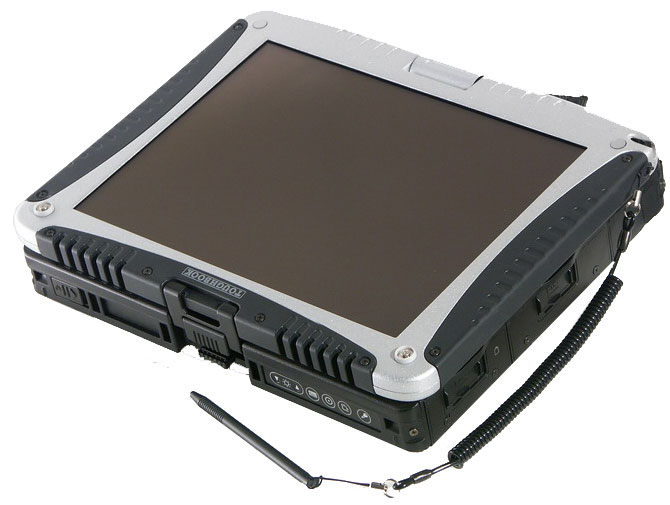
Now let's transform the device to a tablet. In order to rotate the lid, you just have to slide the latch in the center under the display. Now the buttons on the front will come in handy. They can be used to show a virtual keyboard, rotate a display (angles and the default position can be configured),
emulate Enter presses, and Log-off (there is an option, when you will have to enter a password to proceed). All in all, it's a standard set of functions for a Tablet PC.
The touch screen, manufactured by Fujitsu Takamisawa, is rather convenient to work with - one of the reasons is a well thought-out system of settings and calibration.
I managed to configure it for the bundled stylus as well as for my finger. Unfortunately, these settings are different.
Of course, the software bundle includes a utility for creating hand-written notes.
What concerns display characteristics, unfortunately we didn't carry out our instrumental analysis - our hardware complex was only in development at the time of our tests. Viewing angles are subjectively not very good, which is only natural. But the contrast is rather good at the normal to the display surface.
Drawing a bottom line, the notebook is not devoid of drawbacks. While the moderate set of ports is not a drawback and an industrial RS-232 port is an advantage, an inconvenient keyboard hardly has to do with the rugged construction. But if you want to work under environment conditions too rough for regular notebooks, you may lump the drawbacks.
Testing the notebook
Performance of this model is sacrificed to its rugged construction - it's problematic to provide good heat removal in a dust- and water-proof case. That's why there is no point in publishing the results, especially as the only topical test (MobileMark 2002) refused to start up on Toughbook CF-18.
Overall Bottom Line. Conclusions
Panasonic Toughbook CF-18 possesses an aggressive design and high protection from unfavorable environment conditions. Another advantage of this model is its transformation into a tablet.
Its disadvantages include a poor keyboard, and probably its price.
Nikolai Dorofeyev (niko@ixbt.com)
September 16, 2005
Talks about the Intel Pentium M processors with attractive power consumption and relatively low heat dissipation offering good performance have been running for a long time already. They often end with one wish: "If we could just install this CPU into a regular desktop computer!" However, this wish is without foundation, it's based solely on emotions: "I've got a notebook with Pentium M — it's very fast!" Yep, it's fast. It's fast for a notebook. But can we compare performance of a notebook and a desktop directly? In the first case we compare the performance with our previous impressions produced by other notebooks, not by a desktop... So, the problem of correct comparison between Pentium M and desktop CPUs is rather sharp, it certainly must have been solved. Either to make sure that a hypothetic PC with Pentium M inside is really very attractive, or to shatter this myth.
Fortunately, some manufacturers released products that allow a correct performance comparison between Pentium M and regular CPUs. For example, AOpen and DFI launched desktop motherboards based on the Intel 855M mobile chipset (one of them, the DFI mobo, takes part in our tests) and ASUS surprised the world with... an adapter to install a mobile processor into desktop motherboards for Socket 478! But there is a fly in the latter ointment: as a processor must be supported by BIOS just to start up correctly, only ASUS motherboards can work with this adapter, their BIOS supporting Pentium M. Here is a list of such motherboards:
ASUS P4P800-VM
ASUS P4GPL-X
ASUS P4GD1
ASUS P4P800-E
ASUS P4C800-E DELUXE
ASUS P4P800 SE
This adapter won't work with products from other manufacturers (even with ASUS motherboards that are not included in this list). Even if a miracle happens, no one knows how a CPU will be detected and whether it will work correctly (most likely answers to these questions are: incorrectly, badly). However, our attempts to start up a system with an adapter and a couple of Socket 478 motherboards from other manufacturers ended in a failure: the system booted (fans on a video card and a CPU cooler rotated, even the CPU got warm), but the screen remained pitch black.
But let's return to our mobile desktop processors. Our main task in this test was simple: on the one hand, to compare the efficiency of various cores at the same clock (that is roughly speaking, to see how many performance units "in terms of MHz" provide processors of various architectures); on the other hand, to estimate (according to test results) the prospects of a hypothetical "mobile core from Intel on a desktop". In other words, to try and forecast the development of affairs, if Intel suddenly decides to give up NetBurst and create a desktop processor based on the same core as in Pentium M. It's high time to proceed to our tests...
As you can see, the "zoo" is rather large. However, it's rather easy to come to know it, as only two large groups take part in the tests. They can be referred to as "AGP group" and "PCI Express group". The first group, AGP:
Athlon XP 3000+ and a motherboard on nForce2 Ultra, DDR400
Pentium 4 2.8E GHz and a motherboard on i865PE, DDR400
Athlon 64 3700+ and a motherboard on VIA K8T800, DDR400
Pentium M (760/770) and a desktop motherboard on i855M, DDR400 in DDR333 mode
Thus, AGP was conditioned by the motherboard for our contenders (Pentium M) that supports this very graphics bus. The same applies to the second group that uses a PCI Express video card — firstly, because our ASUS motherboard, which supports the Socket 479 —> Socket 478 adapter, is equipped with this very graphics bus; secondly, why not install a more powerful video card on the testbed? PCI Express group:
Pentium 4 540J and a motherboard on i955X, DDR2-533
Athlon 64 3700+ and a motherboard on nForce4 Ultra, DDR400
Pentium M (760/770) and a motherboard on i915, DDR400, Socket 478 with the adapter to 479.
We shall publish the reviews of some of these motherboards (especially of the interesting product from DFI) a tad later (watch the announcements in the Platform section). As for now, have a look at "the coming of Pentium M to desktop" in our test lab.
Socket with an installed cooler, DFI 855GME-MGF.
Socket 479. You will hardly mistake it for Socket 478:
the socket is latched with a screwdriver
instead of a usual lever.
Socket 479 —> 478 adapter, ASUS CT-479 CPU Upgrade Kit, front view.
These two jumpers set the FSB clock — 400 MHz or 533 MHz.
The adapter does not have any other controls.
Socket 479 —> 478 adapter, ASUS CT-479 CPU Upgrade Kit, rear view.
The adapter with a processor installed into Socket 478 on a motherboard.
The same components with an installed cooler
(it's a special cooler that comes shipped with the bundle of this adapter)
The choice of processors is based on quite an evident principle (as far as possible): their clock should be maximum close to the clock of the top Pentium M. The only exception is Pentium 4: it would be evidently outperformed by all equally-clocked competitors, because higher core clocks are the main advantage of this CPU as well as NetBurst architecture as such.
That's why we chose Pentium 4 so that its performance is approximately on the level with Pentium M 770. Of course, at an average that is in all the tests. Fortunately, it's no problem to calculate an average score using Excel GEOMEAN. I emphasize that the average score for Pentium 4 2.8E (in the AGP group) and Pentium 4 540J (in the PCI-E group) is indeed very close to the results of Pentium M 770 (for each group). What concerns "the relative efficiency in terms of MHz", this parameter is of no interest in case of Pentium 4 for the above reasons.
Test results
Remember that diagrams with all test results (61 items!) are published on a separate page — without comments, just as is. The article provides only summary diagrams that calculate the results of entire test groups into average scores. This approach appeases curiosity of the most inquisitive readers, who are against cutting down the number of test results published in our articles, and still makes the article less motley and graphics-intense. What concerns our comments, real professionals (who are interested in details) are expected to need none of them.
The "old" platform represented by Athlon XP and Pentium 4 / Socket 478 looks the least convincing. Pentium M is quite good — it manages to outperform Pentium 4 540 3.2 GHz on the most progressive dual channel chipset with DDR2 (i955) even on a mobile platform. Pentium M demonstrates even higher results (by 8% better at an average) on a desktop platform (i915). However, the first place is still taken by Athlon 64, it outscores the best result of Pentium M by 6%, while its core clock is just 3% higher (2.2 GHz versus 2.13). Thus, Athlon 64 turns out generally more efficient than Pentium M. By the way, don't forget the fact that L2 Cache in Pentium M is twice as large.
Pentium M 770 on a desktop platform demonstrated the best result in this test. The weakest processor is the old Athlon XP 3000+, though its clock is even a tad higher than in the top mobile processor from Intel (2167 MHz). However, its cache is four times as smaller (!), perhaps that's the main reason. A dual channel chipset together with DDR400 (i915) is obviously more preferable to Pentium M than the native mobile i855M — performance gain of the mobile processor on a desktop platform reaches 12%. Which is only natural: even with "just" 533 MHz FSB, the single-channel DDR333 (that's the mode offered by the i855M) cannot supply all CPU wants in terms of memory access times.
Lightwave 8.2, rendering
Quite a motley picture, but the majority of processors demonstrate similar results, there is only one outsider — Athlon XP 3000+. Note that the Pentium M results on the mobile and desktop platforms are approximately the same. It means that the speed of memory operations is practically irrelevant for Lightwave.
Pentium M on the mobile platform goes approximately on a par with Pentium 4 2.8E and Athlon XP 3000+, on the desktop platform — approximately on a par with Pentium 4 540J (3.2 GHz). The fastest processor is Athlon 64 3700+ in both hypostases, as in case of 3ds max 7.
The best result is demonstrated by Pentium 4 540 on the new platform with DDR2, the worst result belongs to the old Athlon XP 3000+. The results of other processors are approximately in the same range. The relatively small gap between the i915 and the i855 can most likely be explained by the fact that 2MB Cache in Pentium M is quite sufficient for Photoshop to make up for the slow memory operations. But that's only within the functions we examine here...
Adobe Acrobat 6.0
Quite an even line, but we still have leaders — Pentium M and Athlon 64.
It's for the second time already that the transition from a mobile platform to a desktop one adds 400 MHz to Pentium M "in Pentium 4 equivalent": while its performance on the i855 is similar to Pentium 4 2.8 GHz, on the i915 it gets on a par with Pentium 4 540 at 3.2 GHz. However, Athlon 64 is still faster, the gain is larger than could be expected from its clock advantage over Pentium M.
We can see again that sometimes a large cache voids the RAM performance advantages of some platforms: Pentium M results on the i855 and i915 are practically identical. But it doesn't mean that they are bad. On the contrary, the only processor that outperforms Pentium M 770 is Pentium 4 540.
CPU RightMark 2004B
Quite symptomatic: the results of Pentium M 770 and Athlon 64 3700+ match both times. Advantages of both Pentium 4 processors in this test are undeniable. And we know for sure about the reasons: only these processors support Hyper-Threading that allows to emulate two CPUs with only one physical core.
3D games and graphics visualization
in professional packages
DOOM 3
AGP group demonstrates evident insufficiency of video card's performance, while PCI Express (ATI Radeon X800) shows CPU dependence. Well, we are quite used to Pentium 4 bringing up the rear in games, but Pentium M is good news — it nearly catches up with Athlon 64. Considering that the latter has a higher clock, we can assume that Pentium M would have caught up with it under equal conditions.
Far Cry
The situation is absolutely the same...
Painkiller
Painkiller dislikes all Intel processors, no exceptions. Though it doesn't favour the processor on the AMD K7 core (Athlon XP 3000+) either. So it would be more appropriate to speak of sympathies to the certain K8 core rather than of love to AMD processors.
Unreal Tournament 2004
In this case Pentium M cannot catch up with Athlon 64. But at least it looks much more convincing than both Pentium 4 processors and Athlon XP.
We can draw the following conclusion about games on the whole: the best efficiency "per a single MHz" is demonstrated by the AMD K8 core represented by Athlon 64, but the Pentium M core is still more attractive for gaming than the Prescott / Pentium 4 core.
But SPEC viewperf sticks to its own opinion, having given the lowest rates to Pentium M in both groups. It's also the only test, where Athlon XP 3000+ outperforms Pentium M. How very strange... As a rule, SPEC viewperf agrees to the rating in game tests...
Conclusion
Well, let's formulate our conclusions. Let's briefly enumerate the interesting facts about Pentium M performance:
We have witnessed many times that a desktop platform with a fast dual channel memory controller added many scores to Pentium M relative to the standard mobile platform. That is this processor has some performance margin (in desktop use relative to mobile computers), even at the same core clock.
Pentium M demonstrated a funny property in many programs that have pronounced CPU preferences: it was rated somewhere in the middle. That is "better than the worst, but worse than the best". On the whole, this behavior is only welcome, as both main competitors (Pentium 4 and Athlon 64) find themselves in the bottom of the list from time to time, so Pentium M is a "steadier" processor.
On the whole, efficiency "per a MHz of a core clock" of the AMD Athlon 64 / Socket 939 is still higher than in Pentium M. But we shouldn't forget about two things: firstly, Pentium M has twice as large L2 Cache (another case against it); secondly, Athlon 64 has a dual channel DDR400 controller, while Pentium M — just a 533 MHz FSB (on the contrary, it speaks well for Pentium M, because if it had 800MHz FSB, its performance could have grown).
The average performance of Pentium M 770 (2.13 GHz clock) on a mobile platform is approximately equivalent to the performance of Pentium 4 "Prescott" at about 2.8 GHz. On a desktop platform it's similar to the performance of Pentium 4 at about 3.2 GHz. There are standard "buts", of course: the data is not precise, but only average; it's not in general, but within our tests.
Thus, it seems a cheery situation at first sight: a processor with little heat dissipation and power consumption operating only at 2.13 GHz that competes with a 3.2 GHz desktop "oven", which power appetite is much higher. But let's get down from Heaven to Earth...
We can assume that if the Pentium M core (let's call this core type "P6+") had been compared to NetBurst cores (especially with the latest Prescott) not now and not by us, but 10 years ago by Intel (when it was deciding on the next desktop CPU), quite a different processor would have been called Pentium 4. But the history recognizes no subjunctive moods. So the correct question is not "Is Pentium M better than Pentium 4 for a desktop?", but "Are Pentium M advantages over Pentium 4 worth restructuring the desktop CPU market (that's inevitable, as Intel's share is about 80% in this segment), model lines, marketing plans, production lines, and development strategies?" That's how the correct question sounds. And the answer to it seems obvious.
It's all the more evident considering that the Pentium M efficiency, according to the test results, is within the same range as the Athlon 64 efficiency. It means that the P6+ core will most likely not bring victory to Intel. For Intel, the hypothetical desktop CPU on the P6+ core is nothing more than a good way to catch up with AMD. To catch up, but not to outrun.
Of course, if the super low (in desktop terms) power consumption is not too critical, the manufacturer may raise the clock (most likely to the level of current desktop processors from AMD, that is up to 3 GHz or lower), overclock FSB, but... If our hypothesis about the similar efficiency of Intel P6+ and AMD K8 cores is correct, Intel will have to launch a P6+ based CPU at a significantly higher clock. And the clock of a top Pentium M processor is currently just 2.13 GHz. That's the top model!
Will Intel manage to make a P6+ based processor at least at 3.2-3.4 GHz (considering that AMD will most likely overcome the 3 GHz limit)? It's doubtful... Besides, subsequent growth of a cache size in Pentium M looks unreal, it has 2 MB already. Moreover, as we have already seen, a superfast bus with this cache size is not always necessary. So the effect of upgrading 533 MHz FSB to 800 MHz or even 1066 MHz may be not that prominent.
That's why our overall conclusion is as follows: indeed, if NetBurst hadn't drawn so much time, effort, and money, the P6+ core could have become quite an attractive basis for desktop processors from Intel in the past and the present. But it does not demonstrate any miracles, Pentium M cannot outperform an equally-clocked Athlon 64. So AMD would have nothing to worry about even in this case. Processors from both manufacturers would have simply been much more similar in their behavior and preferences than they are now. But the NetBurst architecture exists and has been developing for several years already, the Pentium 4 trademark is highly advertised, processors sell well, and Pentium M does not qualify for the hypothetical Pentium 5. Yep, it's good, but not that good. It would be a mistake to promote this solution to the desktop market today, as the new and promising must be better than competing solutions, not just "no worse". So, have a look at the results one more time and sigh for the good desktop processor, which we could have had. But things have not come round as we wanted...




)
)







 If you've been schlepping around a too-heavy, too-slow notebook for too long, Intel and